
Neat! Tips & Strategies
Organize by feel, read every scrap of story, and pace Molly’s eight jobs without rushing the heart of the game.
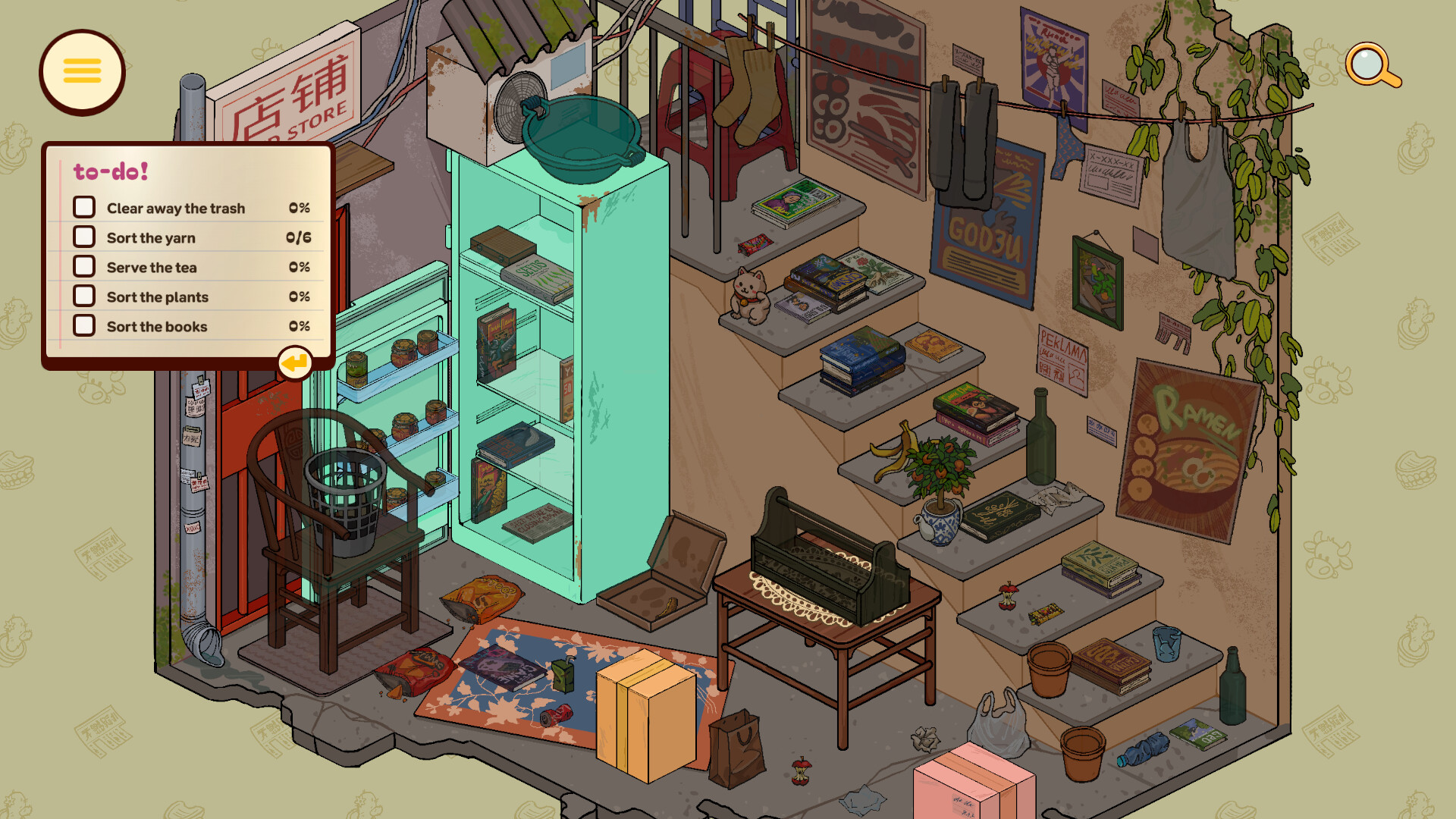
Neat! looks simple—pick up mess, put down order—but the players who love it treat tidying as listening. These tips cover organizing strategies, storytelling reads, pacing, and small habits that make Molly’s eight jobs richer. They complement Getting Started, Locations, and the Walkthrough without demanding a single correct shelf map.
Golden rule: organize by feel
Korova Games does not grade you against one hidden blueprint. If the room feels right for the client, you are doing it correctly. That freedom is the point. Use it:
- Prefer function + emotion over catalog symmetry.
- Leave intentional lived-in clusters when the story says someone is mid-life, not mid-magazine shoot.
- Redo freely. Undo is part of the craft loop, not a failure state.
When you catch yourself optimizing for a screenshot instead of a person, pause and reread the last note you found.
Strategy 1 — Clear in zones
Working the entire room at once creates visual noise and lost objects.
- Pick a surface (table, desk, counter).
- Clear it completely into a temporary holding area.
- Wipe the “mental slate,” then return only what belongs.
- Move to the next zone: floor piles, wall storage, hidden drawers.
Zone clearing shines in the single mom’s kitchen and the konbini, where workflow paths matter, and in the VTuber desk where cable logic fights plushie logic. See Locations for per-space themes.
Strategy 2 — Sort into story piles, not only categories
Categories (books with books, cables with cables) are useful—but Neat! also wants narrative piles:
- Evidence of a recent event (library concert fallout)
- Tools of a job (stream gear, kitchen utensils, retail stock)
- Comfort objects (hermit nesting, haunted-room talismans)
- Paper and tape media (the plot delivery system)
Sort physically, then read. Many “why is this here?” answers are printed on the object underneath.
Strategy 3 — Read early, not at the end
A common mistake: tidy everything, then skim notes like optional DLC. In Neat!, letters, tapes, and scraps change what good organization means. Practical habit:
- Whenever you fully uncover a readable or playable story item, stop and consume it before more sorting.
- Adjust your layout hypothesis after each reveal.
- If audio overlaps a vibe shift, give it headphones time—soundtrack and tapes are part of the design.
Demo footage (including longer demo showcases like the Best Spuds video embedded here) is useful for watching this cadence before you mirror it in the full game.
Strategy 4 — Pace the short campaign
A full run is about 3.5–4 hours. That brevity tempts binge-tidying. Better pacing options:
- One location per session for maximum story absorption.
- Two locations if evenings are short and energy is high.
- Take a stretch break on transitions—especially before the finale’s personal space.
Pacing also helps achievement hunting later: you will remember where odd interactions lived. Confirmed titles like Stationery Addict, Room Reboot, Touch Grass… Later, and Chef’s Kiss reward attentive play; see Achievements for responsible 100% guidance without fake names.
Strategy 5 — Match layout to client psychology
Ask four questions in every room:
- What does this person do here daily?
- What are they proud of displaying?
- What are they hiding—from guests or from themselves?
- What would reduce their next-morning stress?
Examples:
- Garden: pride in care, paths for aging knees, tools within honest reach.
- Haunted living room: safety and sightlines may matter more than coffee-table magazines.
- Hermit room: indoor logistics over “you should go outside” moralizing.
- Konbini: next shift’s muscle memory over your personal aesthetic.
Compassion beats minimalism. Molly’s startup framing is care work wearing an organizer’s badge.
Strategy 6 — Use the camera like a tool
Bad angles create fake problems. Before you blame an object:
- Frame the landing surface.
- Orbit so shelf lips and gravity make sense.
- Zoom until labels are readable.
- Reset when the camera clips.
Full input notes live in Controls, including Deck and partial controller advice.
Strategy 7 — Hold a “maybe” box
Mentally (or physically in a corner) keep a maybe pile for items you cannot place yet. Often a letter two minutes later tells you where they belong. Empty the maybe pile before you call a location finished.
Strategy 8 — Screenshot layouts you love
Steam screenshots help if you:
- Want to compare with friends (disagreement is healthy).
- Return for achievement cleanup and forgot a shelf state.
- Write your own notes for a second emotional pass after the Review mindset hits.
Enable Steam Cloud if you switch between PC and Deck mid-campaign.
Strategy 9 — Don’t fight the genre cousins—learn the difference
If you come from Unpacking or similar cozy organizers:
- Expect more client variety across eight authored spaces.
- Expect story via found media, not only placement vibes.
- Expect outdoor and retail jobs beside domestic ones.
- Do not import a rigid “everything in labeled bins” religion if the character would never live that way.
The Review digs into audience fit and comparisons more bluntly.
Quick tip sheet
| Situation | Try this |
|---|---|
| Feeling overwhelmed | Shrink to one zone |
| Layout feels sterile | Reintroduce one sentimental cluster |
| Stuck on meaning | Find the next unread note/tape |
| Hands tired | Switch mouse/Deck; stretch between rooms |
| Want structure | Open Walkthrough |
| Want themes | Open Locations |
| Want 100% | Open Achievements |
| Want specs | Open System requirements |
A closing habit
Before you leave any of Molly’s jobs, stand on the “client threshold” mentally and ask: Could this person have a kinder next day here? If yes, you are neat enough. If not, one more zone usually reveals what still aches—often under a letter you have not read yet.
Keep Updates and Launch notes handy for patch changes, and Wiki / links for official neatga.me and @Neatthegame pointers. Then get back to the piles—kindly, slowly, and by feel.
Frequently Asked Questions
Quick answers about Neat!, Molly, and this fan wiki.
What is the most important Neat! tip?
Organize by feel for the client, and read letters/tapes as you uncover them instead of saving all story for the end.
How should I pace the game?
One location per session is ideal for story. Two per night works if you stay attentive. The full run is about 3.5–4 hours.
Is there a wrong way to arrange a room?
Only if you ignore the client’s story. Sterile perfection that contradicts notes and tapes is usually the real mistake.
Do tips differ by location?
The zone method is universal, but psychology changes: gardens, haunted rooms, hermit nests, and konbini closings each want different priorities—see Locations.
Can watching demo videos help?
Yes for cadence and camera habits. Mirror the patience, not someone else’s exact shelf layout.